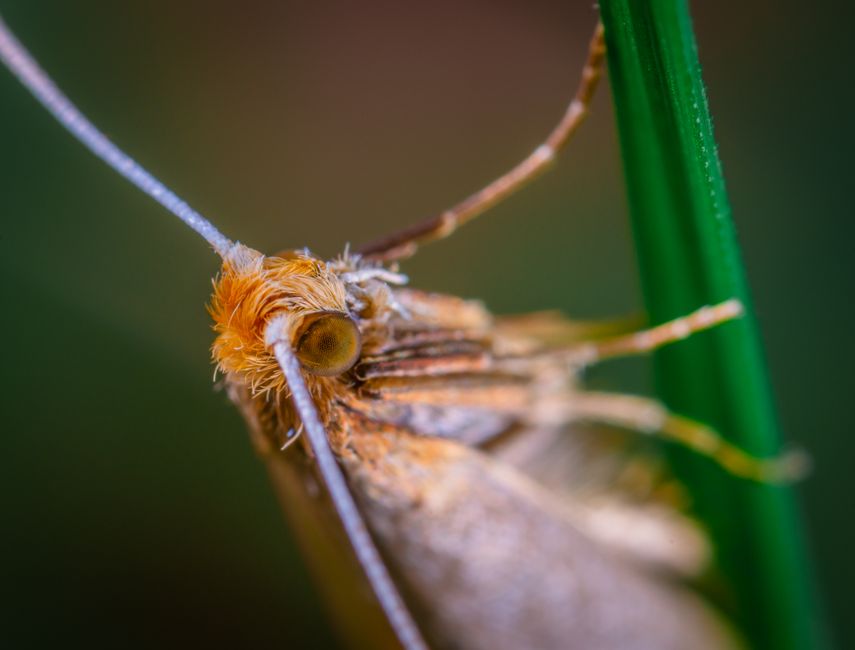
An increasing number of photographers are setting aside sweeping landscapes in favour of the miniature wonders of the natural world, embracing macro photography to reveal details that are invisible to the naked eye — such as the facets of a fly’s eye or the geometric patterns on a spider’s face.
It is a demanding form, and practitioners describe it as both challenging and captivating. Wildlife photographer Dara Ojo, among those who have turned to the niche, says he regularly spends minutes, hours, or even days waiting for a shot, often hoping that his tiny subjects will simply stay still. Insects, he notes, are rarely cooperative.
The genre has grown steadily in popularity in recent years, driven by a wave of macro influencers, cheaper lenses, and the pandemic, which left many photographers with little more than their own back gardens to shoot. But the craft is technically difficult. It depends heavily on ‘focus stacking’ — combining multiple images taken at different focus distances into a single sharp photograph. That is hard enough with a static subject; add an insect that can fly away mid-shoot, or a gust of wind, and a single successful frame can represent hours or days of failed attempts.
For Ojo, 35, the enchantment with small things goes back to his childhood in Lagos, Nigeria, where he planted yam, corn, tomatoes and beans with his late father, describing the process of watching tiny seeds grow as magical. That wonder resurfaced during the pandemic, while he was based in China and photographing birds. When he felt his photography had become stagnant, a friend recommended insects. Seeing them up close for the first time left him fascinated by the intricate design of their faces. His favourite capture to date is a video of a damselfly grooming itself — a moment he pursued for two or three years. He eventually filmed it at sunrise in a botanical garden, after waiting an hour and a half for the insect to perform. He jokes that macro photography is not the discipline for anyone hoping to get their steps in.
The field also offers increasingly viable ways to make a living. A well-managed macro account can earn money through monetisation, print sales, books, and partnerships with camera and lens manufacturers who want specialist content.
Others share Ojo’s path. In the Netherlands, Marit van Ekelenburg — who photographs under the name Macro by Marit — began eight years ago when her mother asked her to capture her garden. She had never held a professional camera at the time, but what began with flowers quickly shifted to the bees and weevils found inside them. She taught herself through hours of practice and persistent trial and error, and was drawn in by the ability to see structures and colours that ordinarily evade the eye. Her advice: the subjects are close by and walked past every day.
In France, biologists Maceo and Andrea Grammatico, known jointly on Instagram as TwinWildLens, discovered macro through YouTube tutorials about two years ago and saved up for their first dedicated lens. They chose insects because of the great variety of shapes, colours and behaviours, and because such creatures can be found in a garden or nearby forest. Their most memorable shoot required three days of searching Mediterranean scrubland for a conehead mantis, which they finally found in the last hours. A trip to Costa Rica brought offerings from frogs and snakes to a moth they nicknamed the ‘Dobby moth’.
What unites these photographers is a desire to show that insects, often avoided or ignored, can be beautiful when finally seen up close. Many people, van Ekelenburg notes, have simply never been shown that side of them.